The Modern SEO Industry Is Drowning In Data
Every year the SEO industry becomes more sophisticated.
We have more tools.
More reports.
More dashboards.
More metrics.
More crawl data.
More analytics.
More notifications.
More exports.
More subscriptions.
More information than ever before.
Yet despite having access to incredible platforms such as Google Search Console, Google Analytics 4, Screaming Frog and Sitebulb, many SEO professionals find themselves asking the same question at the end of the day:
What should I actually do next?
This is the question nobody seems to be solving.
And it is exactly why Growth Architect AI was built.
The Real Problem Is Not A Lack Of SEO Data
For years, software companies have focused on helping SEO professionals collect more information.
But modern SEO does not suffer from a lack of information.
It suffers from a lack of clarity.
Google Search Console provides data.
Google Analytics 4 provides data.
Screaming Frog provides data.
Sitebulb provides data.
Rank trackers provide data.
Backlink tools provide data.
The problem is that most SEO professionals already have access to more information than they can realistically process.
The challenge is no longer:
“How do I collect more data?”
The challenge is:
“How do I turn all this data into meaningful action?”
This is where Growth Architect AI becomes different.
Welcome To The Era Of SEO Data Fatigue
SEO professionals rarely talk about it.
But almost everyone experiences it.
We call it:
SEO Data Fatigue
You open Google Search Console.
You review impressions.
You review clicks.
You review coverage.
You review indexation.
You review queries.
You review pages.
You export the data.
Then you open Google Analytics 4.
You review landing pages.
Traffic sources.
User behaviour.
Engagement metrics.
Conversions.
Then you launch Screaming Frog.
Then Sitebulb.
Then another report.
Then another export.
Then another dashboard.
Hours later you have collected thousands of data points.
Yet the most important question remains unanswered.
What deserves my attention first?
Growth Architect AI was created to answer that question.
Growth Architect AI Was Built Around Three Critical Questions
Everything inside the platform revolves around three simple questions.
Questions that every SEO professional, agency and business owner eventually asks.

Top Actions window showing the Deep Dive options
Question #1: What Should I Do Next?
This is the foundation of Growth Architect AI.
Most SEO tools tell you what exists.
Growth Architect AI helps you determine where to focus.
The software identifies opportunities such as:
- High impressions but low traffic
- Ranking pages with low click-through rates
- Valuable orphan pages
- Indexed pages that are not ranking
- Important pages receiving no traffic
- Thin content opportunities
- Hidden SEO growth opportunities
- Revenue-impacting SEO risks
Instead of manually reviewing thousands of URLs, users receive prioritised actions.
Not more reports.
Not more dashboards.
Actions.
Because growth happens when action happens.
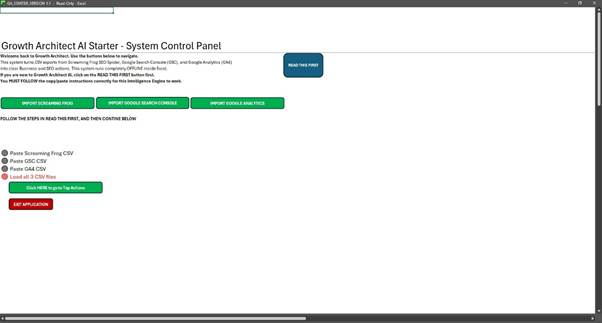
Screenshot of the System control panel allowing data to be pasted
Question #2: How Can I Do My SEO Work More Safely?
This question is becoming increasingly important.
Every day agencies, consultants and businesses upload sensitive information into cloud platforms.
Client websites.
Crawl exports.
Revenue data.
Analytics data.
Search Console data.
Business intelligence.
The SEO industry has quietly become dependent on cloud-based software.
Most people accept this without asking a very important question:
Who owns the data?
Growth Architect AI takes a different approach.
Growth Architect AI is offline SEO software.
Your data stays where it belongs.
With you.
On your computer.
Under your control.
No client crawl data uploaded to third-party platforms.
No business-critical information stored on unknown servers.
No concerns about who has access to sensitive information.
No concerns about how your data may be used in the future.
Your data remains your data.
Your client data remains your client data.
Your analysis remains your analysis.
In a world increasingly dependent on cloud software, Growth Architect AI provides something surprisingly rare.
Ownership.
Privacy.
Control.
Why Offline SEO Software Matters More Than Ever
Many people hear the word “offline” and immediately assume it means old-fashioned.
The reality is quite the opposite.
Offline software offers several significant advantages.
Better Data Privacy
Sensitive business information never leaves your environment.
Better Control
You remain in complete control of your data.
Reduced Dependency
Your workflow is not dependent on external servers or subscription platforms.
Faster Analysis
Large datasets can be processed locally without waiting for cloud processing queues.
Long-Term Stability
Your ability to perform analysis is not dependent on somebody else’s pricing model, infrastructure or future business decisions.
For agencies and consultants working with sensitive client information, this matters.
A lot.
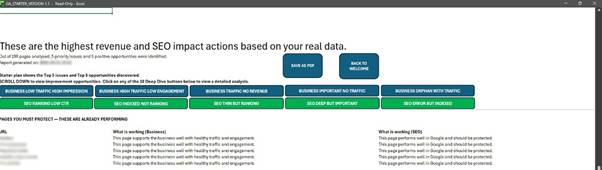
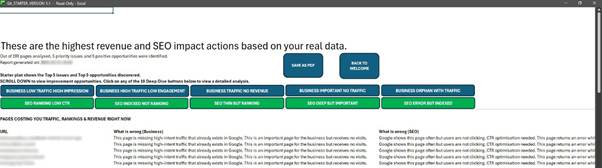
Top Actions window showing priority issues and positive opportunities
Question #3: How Do SEO Professionals And Business Owners Finally Speak The Same Language?
This may be the most overlooked challenge in modern SEO.
SEO professionals talk about:
- Canonical tags
- Crawl depth
- Redirect chains
- Indexation
- Structured data
- Internal linking
Business owners talk about:
- Leads
- Sales
- Revenue
- Growth
- Customers
Both perspectives are important.
The challenge is connecting them.
Growth Architect AI was designed to bridge that gap.
Instead of simply highlighting technical issues, the platform focuses on opportunities and risks that can influence business outcomes.
This changes the conversation.
Instead of saying:
You have 2,000 duplicate title tags.
You can say:
These are the opportunities most likely to improve visibility, traffic and revenue.
Business owners understand that.
Decision-makers understand that.
And suddenly SEO becomes easier to communicate.
Growth Architect AI Does Not Replace Your Current SEO Tools
It does not replace Google Analytics 4.
It does not replace Screaming Frog.
It does not replace Google Search Console.
In fact, these are some of the most powerful SEO tools available.
Growth Architect AI was never designed to compete with them.
It was designed to help make sense of them.
Think of it this way.
Google Search Console tells you what Google sees.
Google Analytics 4 tells you what users do.
Screaming Frog tells you what exists.
Growth Architect AI helps determine:
What matters most.
And more importantly:
What happens next.
Less Noise. More Direction.
The SEO industry already has incredible tools.
What it often lacks is direction.
Most professionals do not need more information.
They need clarity.
They need prioritisation.
They need confidence.
Confidence that they are focusing on the right pages.
Confidence that they are fixing the right issues.
Confidence that they are protecting their client data.
Confidence that they are spending their time where it matters most.
This is what Growth Architect AI was built to provide.
Final Thoughts
The future of SEO is not about collecting more data.
The industry already has enough data.
The future belongs to professionals who can identify the right opportunities, prioritise the right actions and make better decisions faster.
Growth Architect AI was built for exactly that purpose.
Not to generate more reports.
Not to create more dashboards.
Not to add more complexity.
But to help SEO professionals, agencies and businesses answer three simple questions:
What should I do next?
How can I do my SEO work more safely?
How do I turn technical SEO insights into business growth?
Because successful SEO is not determined by who collects the most information.
It is determined by who takes the right action at the right time.
And that is exactly what Growth Architect AI was built to help you do.
Not ready for a paid edition?
Experience the same Growth Architect AI intelligence engine free for 7 days with Starter.
Experience Starter Free →